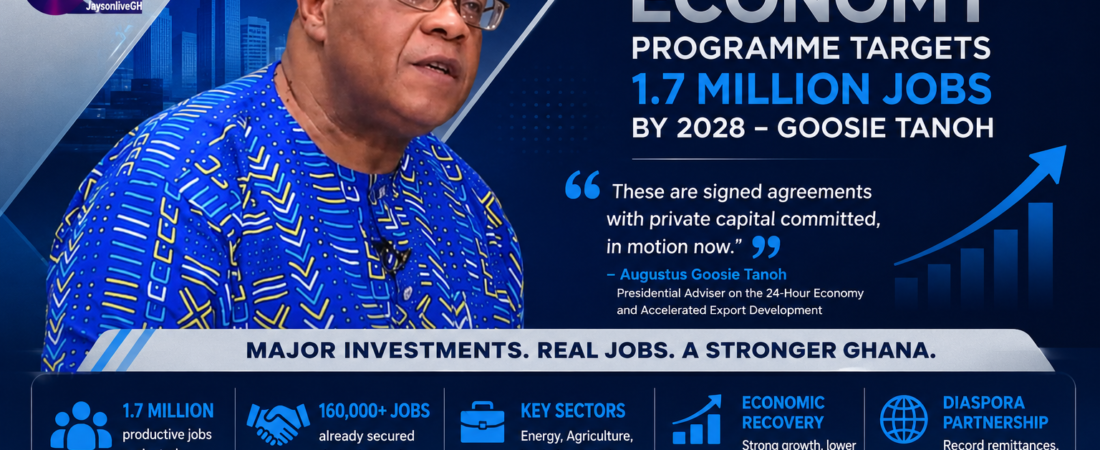
Ghana’s ambitious 24-Hour Economy Programme is rapidly moving from policy to implementation, with government projecting the creation of 1.7 million productive jobs by 2028 through a series of large-scale investments and export-driven projects.
Speaking at the Ghana Diaspora Townhall Meeting in London, Presidential Adviser on the 24-Hour Economy and Accelerated Export Development Programme, Augustus Goosie Tanoh, disclosed that agreements signed within the last 90 days alone are expected to generate more than 160,000 direct jobs.
The announcement forms part of the Mahama administration’s broader strategy to accelerate industrialisation, boost exports, attract private investment and create sustainable employment opportunities across the country.
Multi-Billion Dollar Projects Already Taking Shape
According to Mr. Tanoh, several key projects are already in motion and backed by committed private-sector investment.
Among them is the $1.45 billion Buipe Solar Farm, expected to create 13,000 jobs while delivering affordable industrial power to businesses.
The Kambonwule Oil Palm Anchor Project, valued at $300 million, is projected to generate approximately 120,000 jobs while helping Ghana reduce its dependence on imported vegetable oils.
Government is also pushing ahead with the Bioenergy and Biofuels Programme in Buipe and Damanko, which is expected to create 30,000 jobs and save the country an estimated $450 million annually in foreign exchange.
Meanwhile, preparations are advancing for the Tamale Air Cargo Hub, a project designed to position Northern Ghana as a major export and logistics gateway for West Africa.
A Shift From Consumption to Production
Mr. Tanoh stressed that the 24-Hour Economy Programme is not simply about extending working hours but about transforming Ghana into a production-driven economy capable of competing globally.
While Ghana’s economy recorded strong growth in recent years, he noted that the services sector continues to dominate economic activity, leaving significant room for industrial expansion.
The programme seeks to bridge that gap by boosting manufacturing, agro-processing, exports and value-added production.
“These are not future plans. These are active projects with signed agreements and committed capital already being deployed,” Mr. Tanoh stated.
Economic Indicators Point to Recovery
The adviser highlighted several positive economic developments that he believes create a favorable environment for investment and growth.
According to him, inflation has dropped significantly, public debt levels have declined, foreign reserves have strengthened and economic growth remains on an upward trajectory.
These improvements, he argued, provide a strong foundation for the successful rollout of the 24-Hour Economy agenda.
Diaspora Investment Key to Success
Mr. Tanoh also encouraged Ghanaians living abroad to take advantage of emerging opportunities within the programme.
With remittance inflows reaching record levels, government believes the diaspora can play a crucial role in financing businesses, supporting exports and driving innovation across multiple sectors.
His message was simple: Ghana is open for investment and ready for the next phase of economic growth.
Jaysonlive Analysis
The success of the 24-Hour Economy Programme could significantly reshape Ghana’s labour market over the next few years. While the 1.7 million-job target is ambitious, the government’s ability to convert signed agreements into operational projects will ultimately determine the programme’s long-term impact.
If successfully implemented, the initiative could become one of the largest job-creation and industrialisation programmes in Ghana’s recent history.
For the latest business, finance, politics and economic development stories from Ghana and around the world, keep reading Jaysonlive.com.