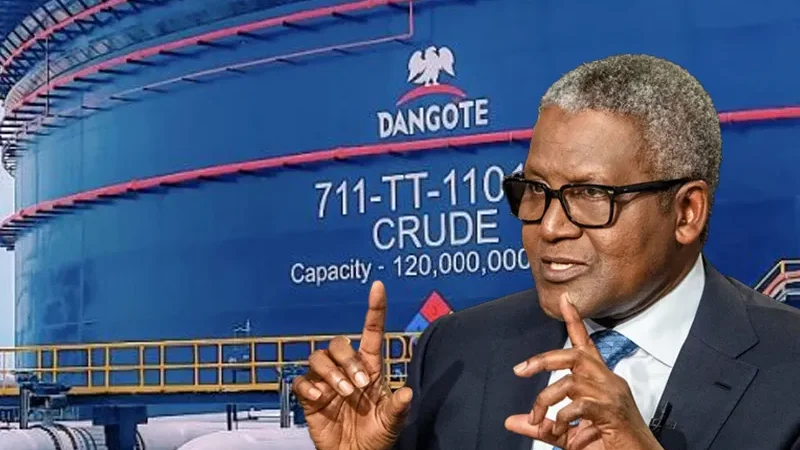
Dangote Refinery Surpasses Its Own Capacity Limit and the Expansion Has Only Just Begun
The Dangote Petroleum Refinery has crossed a landmark threshold, raising its crude oil processing capacity to 700,000 barrels per day and exceeding its official nameplate capacity of 650,000 barrels per day. The achievement cements the facility’s standing as the world’s largest single-train petroleum refinery and signals that its most ambitious phase of growth is still ahead.
The milestone was confirmed during a performance test conducted by the refinery’s process licensors, demonstrating not just the facility’s raw scale but its operational efficiency and ability to push beyond designed limits while maintaining output quality across production units.
Devakumar Edwin, Vice President of Oil and Gas at Dangote Industries Limited, confirmed that this is not the ceiling. The refinery is targeting a processing capacity of 1.4 million barrels per day within the next 30 months, a figure that would make it the largest refinery on the planet by a considerable margin.
Since commencing fuel production in 2024, the Dangote Refinery has moved quickly from a domestic supply story to a genuine player in global energy markets. The facility now exports refined petroleum products including petrol, diesel and aviation fuel to multiple African countries as well as European markets spanning the United Kingdom, France, Spain, Italy and the Netherlands.
The refinery has also supplied gasoline to the United States and jet fuel to Saudi Arabia, a detail that speaks volumes about the quality and competitiveness of its output. In April, S&P Global Commodities confirmed the facility had become the world’s largest exporter of jet fuel, a title that few could have imagined an African refinery holding just a few years ago.
The broader implications of Dangote’s growing output extend well beyond Nigeria’s borders. The refinery has played an increasingly important role in stabilising fuel supply across the African continent, particularly at a time when geopolitical tensions in the Middle East have disrupted traditional energy supply chains. Several African nations now rely on the facility as a critical source of refined petroleum products.
Within Nigeria, the refinery has meaningfully reduced dependence on imported fuel, easing pressure on foreign exchange reserves and capturing more value from the country’s own crude oil resources rather than exporting raw feedstock and buying back refined products at a premium.
Edwin was clear that the refinery’s ambitions extend far beyond meeting domestic demand. The goal is continental and global refining leadership, and the current trajectory suggests that target is not as distant as it might once have seemed.
The refinery’s economic contribution is also expected to deepen as expansion progresses. Future output will include liquefied petroleum gas, polypropylene and other industrial feedstocks that supply downstream manufacturing sectors including packaging, consumer goods and detergent production. Plans also include the production of Linear Alkylbenzene, a key raw material in detergent manufacturing, broadening the facility’s industrial footprint well beyond conventional fuel refining. The expansion is expected to generate significant economic benefits through increased industrial activity, job creation, export earnings and improved trade balances across the region.
Jaysonlive Analysis
What Dangote has built in Lagos is one of the most consequential industrial projects in Africa’s modern economic history. Exceeding nameplate capacity within its first full year of fuel production is a strong operational signal. If the 1.4 million barrel per day target is achieved by 2028, Nigeria will not simply be energy independent. It will be one of the world’s most important refining hubs.
The challenge, as always, will be execution at scale. Feedstock sourcing, infrastructure reliability and sustained investment will all need to align. But the foundation being laid is serious, and the refinery’s growing global footprint suggests Aliko Dangote’s vision for the facility is being realised faster than many expected.
For the latest business, energy, investment and African economic development news, keep reading Jaysonlive.com.