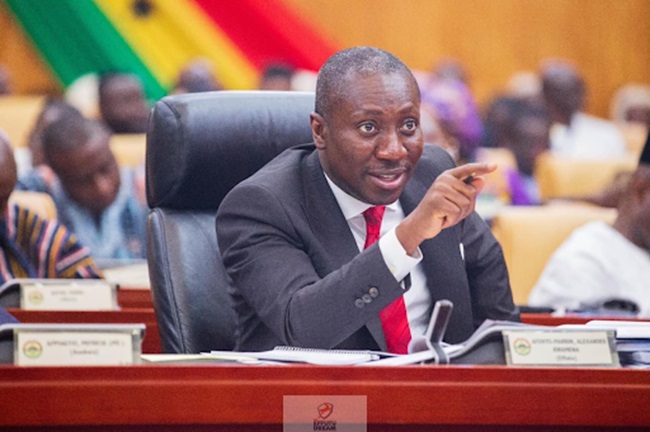
The debate over Ghana’s proposed mobile money transfer charges has taken a fresh turn, with the Minority in Parliament calling for a complete and permanent cancellation of the controversial fee.
Although the Bank of Ghana recently directed Mobile Money Fintech Limited (MMFL) to suspend plans to introduce a 0.75% charge on certain wallet-to-bank and bank-to-wallet transactions, the opposition believes the temporary suspension is not enough.
According to the Minority, Ghanaians deserve assurances that such charges will not be introduced through the backdoor without the approval of Parliament.
Minority Wants Fee Scrapped for Good
Speaking to the media in Parliament, Minority Leader Alexander Afenyo-Markin said the proposed transaction charge should be abandoned entirely unless it receives formal parliamentary approval through legislation.
He argued that any fee that resembles a tax or levy must follow the constitutional process and be approved by lawmakers before being imposed on citizens.
According to him, the central bank should move beyond suspending the fee and permanently prohibit any similar charges that have not been sanctioned by Parliament.
Concerns Over Constitutional Process
The opposition caucus believes the attempted introduction of the charge raises important legal and constitutional questions.
Mr. Afenyo-Markin argued that using fintech operators to collect levy-like charges without parliamentary approval could set a dangerous precedent and potentially undermine Ghana’s constitutional framework.
He stressed that Parliament remains the only institution with the authority to approve taxes and levies imposed on the public.
Attorney-General Asked to Clarify Legal Position
To settle the growing controversy, the Minority is calling on the Attorney-General and Minister for Justice to provide a formal legal opinion on the matter.
The caucus wants clear guidance on whether transaction-based fees of this nature can be introduced through financial technology companies without going through Parliament.
According to the Minority, such clarification is necessary to protect constitutional processes and prevent future disputes.
Finance Minister Under Pressure
The opposition is also demanding answers from Finance Minister Dr. Cassiel Ato Forson regarding the origins of the proposed charge.
Mr. Afenyo-Markin wants the Finance Minister to appear before Parliament and explain whether government officials were aware of the proposal before it became public and whether there was any involvement from the executive branch.
The Minority believes Ghanaians deserve transparency on a matter that directly affects millions of mobile money users across the country.
A Growing Public Debate
The proposed fee sparked widespread discussion among consumers, businesses, and digital finance users, many of whom expressed concerns about additional costs being placed on electronic transactions.
With mobile money playing a crucial role in Ghana’s economy, critics fear that extra charges could discourage digital payments and place additional pressure on households already dealing with rising living costs.
For now, the Bank of Ghana’s intervention has halted the rollout, but the political and legal debate surrounding the issue is far from over.
As pressure mounts on government officials and regulators, many Ghanaians will be watching closely to see whether the proposal is abandoned permanently or returns in a different form in the future.
🔥 For the latest juice in politics, business, finance, entertainment, lifestyle, sports, and trending stories from Ghana and beyond, keep it locked on Jaysonlive.com — your trusted source for the stories shaping the nation and the world.